
Ever Wished You Have Marketing Superpowers?
Here are sites that will give you them!
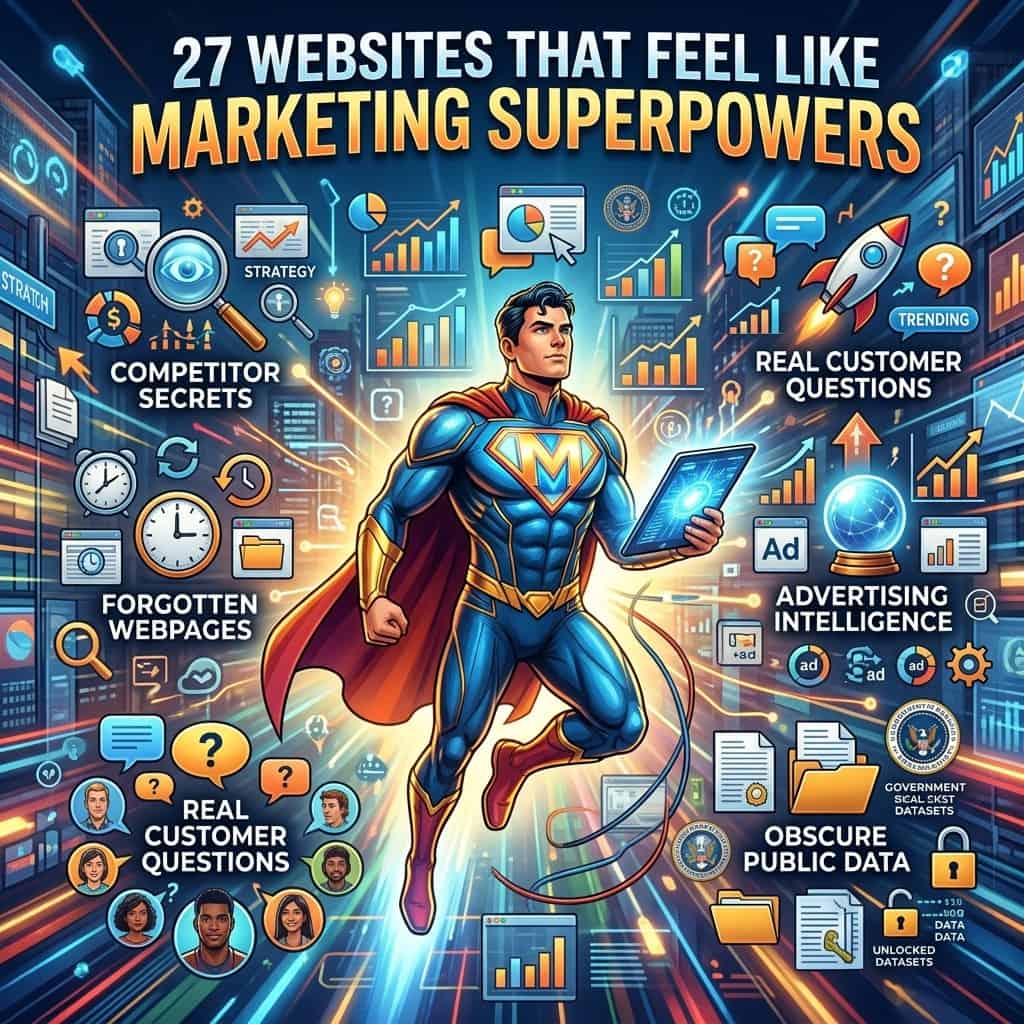
Competitor secrets, forgotten webpages, real customer questions, emerging trends, advertising intelligence and obscure public data – these are the websites worth keeping in your marketing back pocket.
These are websites that let you see things you normally couldn’t see: What technology a competitor is using, what its website looked like three years ago, what ads it’s currently running, what questions customers are secretly asking, which trends are beginning to accelerate, where competitors are getting backlinks, and even what a public company is quietly telling investors.
Some are well known among specialists but practically invisible to ordinary marketers. Others are hiding in plain sight.
Bookmark liberally.
- BuiltWith — Peek Under Any Website’s Hood
Research a successful competitor and find out what they’re using to run the business. You may discover their email platform, ecommerce technology, advertising tools or conversion software without asking them a thing.
- Similarweb — Estimate Where a Competitor’s Traffic Comes From
Don’t merely ask, “How much traffic does that competitor get?” Look for where it appears to come from. If one competitor seems unusually strong in search and another gets substantial referral traffic, you’ve just found two strategies worth investigating.
https://www.similarweb.com/website/
- Exploding Topics — Find Trends Before Everybody Calls Them Trends
Search your industry and look for something rising that your competitors still aren’t writing about. The goal isn’t to chase today’s viral topic. It’s to find tomorrow’s obvious topic while it still isn’t obvious.
- AlsoAsked — See the Questions Behind the Question
Enter the main topic of an article you’re planning. Instead of writing one answer around one keyword, use the question tree to discover the next five questions your reader is likely to ask.
- AnswerThePublic — Eavesdrop on Searchers
Search your product category—not your brand—and pay particular attention to the awkward, specific questions. Those frequently make better emails, FAQs and article ideas than broad high-volume keywords.
- SparkToro — Find Out Where Your Audience Already Hangs Out
Instead of asking, “Where should I promote this?” ask SparkToro what your audience already watches, reads and follows. Then look for partnerships, guest appearances, sponsorships and communities in those places.
- Google Trends — Compare What People Want Before You Commit
Before naming a product, choosing an article topic or betting on a niche, compare several possibilities. One may be steadily climbing while another has quietly been declining for years.
- Google Dataset Search — Find Data Nobody Else Bothered to Look For
Search your industry plus words such as survey, prices, consumers, businesses, spending, or demographics. You may uncover source material for an original article, report, infographic or statistic competitors haven’t recycled 200 times.
https://datasetsearch.research.google.com/
- Census Business Builder — Free Market Research From the U.S. Government
Research the actual characteristics of a geographic market before targeting it. This can be especially useful for local businesses, franchises, B2B sellers and anyone evaluating where customers or businesses are concentrated.
- Really Good Emails — A Giant Email Swipe File
Before creating a welcome email, abandoned-cart message, launch email or promotion, see how accomplished brands have approached the same job. Don’t copy the wording. Study structure, timing, hooks and calls to action.
- Milled — Search Other Companies’ Email Campaigns
Search a competitor before Black Friday, Valentine’s Day or Christmas and see what they’ve historically sent. You can uncover promotional rhythms, discount patterns and positioning without joining 75 mailing lists yourself.
- Swiped — Study Marketing That Actually Has History Behind It
When every modern landing page starts looking identical, go backward. Study old direct-response ads and sales letters for hooks, guarantees, curiosity, proof and offer construction that still work because human psychology hasn’t changed nearly as much as website design has.
- Meta Ad Library — See What Competitors Are Advertising Right Now
Search competitors and pay attention to ads that appear repeatedly or in multiple variations. You can’t see their profitability, but sustained campaigns can give you clues about the offers, angles and creative concepts worth studying.
https://www.facebook.com/ads/library/
- TikTok Creative Center — See What’s Working Before Making Your TikTok
Filter Top Ads by industry and study the first few seconds. You’ll quickly see how marketers in your category are earning the stop before worrying about the rest of the video.
https://ads.tiktok.com/business/creativecenter/
- Social Blade — Watch Creator Growth Instead of Follower Counts
When researching potential influencers, don’t look only at how big they are. Look at how they’re growing. A 60,000-follower creator with accelerating growth may be far more interesting than a 500,000-follower account that’s been stagnant for a year.
- Wayback Machine — Time Travel Through Your Competitors’ Websites
Look at a successful competitor today—then look at it three or five years ago. You can sometimes reconstruct its evolution: old offers, former positioning, pricing changes, product launches and the point where the business apparently changed direction.
- Visualping — Get Told When a Competitor Changes Something

Monitor a competitor’s pricing page, jobs page, product page or important landing page. Instead of remembering to check manually, let the page tell you when something changed.
- Built a Competitor Watchlist? Add Google Patents
Search important companies in a technology-heavy niche. Patents aren’t product announcements and shouldn’t be treated as promises of what a company will launch, but they can provide fascinating clues about problems companies are trying to solve and directions they’re exploring.
- USPTO Trademark Search — Spot Names and Brands Being Protected
Search competitors periodically. New trademark applications can sometimes reveal prospective brand names, product names and positioning directions before consumers encounter them.
- Ahrefs Free Backlink Checker — Discover Who Sends Competitors Authority
Put in a competitor and investigate why other sites link to it. Was it cited for research? A calculator? A guide? A free tool? A statistic? Instead of asking, “Where can I get backlinks?” ask “What did my competitor create that made somebody want to link?”
https://ahrefs.com/backlink-checker
- Hunter — Find the Person Behind the Company
You find the perfect site for a partnership, guest appearance, expert quote or newsletter collaboration—but can’t figure out whom to contact. Hunter can help bridge the gap between finding an opportunity and reaching the human being behind it.
- Meta Tags — See Your Link Before Everyone Else Does
Before publishing an important sales page or article, preview it. A fantastic piece of content can lose clicks simply because the headline truncates badly or the social image looks terrible.
- Google Rich Results Test — Find Out What Google Understands
Run important pages through it, particularly products, recipes, events and other content using structured data. You may discover that carefully added schema isn’t doing what you thought it was doing.
https://search.google.com/test/rich-results
- Schema Markup Validator — Check the Language Machines Read
As search and AI systems increasingly need to understand what your company, products, people and content are, clean structured data becomes worth paying attention to. This is a fast way to spot markup problems.
- PageSpeed Insights — Find the Invisible Conversion Killer
Run your highest-value pages—not merely your homepage. Test your sales page, checkout, lead-generation page and top traffic page. You may be spending weeks improving copy while visitors are spending seconds waiting for the page to load.
- Security Headers — Give Your Website a Quick Security Reality Check
Marketing isn’t much use if the website underneath it is poorly protected. You don’t need to understand every result yourself; a bad score gives you something concrete to hand your developer or host and ask, “Should we fix this?”
- Down for Everyone or Just Me — The Website Marketing Panic Button
Your checkout suddenly won’t load. Your landing page appears dead. Your email is scheduled to go to 20,000 people in five minutes. Before tearing apart WordPress, restarting your router and accusing the intern: Check whether the site is actually down.
https://downforeveryoneorjustme.com/
The Real Superpower: Combine Them
The biggest opportunity isn’t using these sites individually.
It’s stacking them together.
Suppose you find a competitor growing unusually quickly with Similarweb. Check its old website with Wayback Machine. Use BuiltWith to see what technology changed. Put its pricing page into Visualping. Search Meta and Google’s ad libraries for its current campaigns. Check its backlinks with Ahrefs. Look at Google Trends to see whether demand for the category is rising.
You’ve just gone from:
“That competitor seems to be doing well.”
to:
“Here’s what changed, how they’re positioning themselves, what they’re advertising, which sites are talking about them and whether the market itself is growing.”
That’s intelligence.
Or suppose you need your next big content idea. Use Exploding Topics to find a growing subject, Google Trends to verify momentum, AlsoAsked and AnswerThePublic to find the questions surrounding it, Reddit statistics to locate relevant communities, Google Dataset Search to find original supporting data, and Really Good Emails to study how other marketers package similar ideas.
Now you’re not sitting in front of a blank page asking:
“What should I write about?”
You’re assembling evidence.
One Final Rule: Start with Just Five
Choose one for competitors, one for customer research, one for trends, one for content inspiration and one for website intelligence.
Then create a recurring 30-minute Marketing Intelligence Session once a week.
Look for…
- One competitor move you hadn’t noticed.
- One question customers are asking.
- One topic gaining momentum.
- One marketing idea worth stealing—not copying, but adapting.
- And one problem on your own website worth fixing.
Do that every week for a year and these aren’t merely handy websites anymore.
They’re your own little marketing intelligence network.