
Welcome to the Grand Finale of Unusual Businesses
We’ve come a long way from the Yodeling Pickle in part 1.
In Part One, we met ten wonderfully unlikely products that proved you don’t necessarily need a revolutionary invention to build a remarkable business. Sometimes you need an ordinary product with a better story, a neglected customer, a surprising twist or enough personality to make people say, “You have GOT to see this.”
In Part Two, we stopped admiring those businesses and started reverse-engineering them. You learned to use the Opportunity Lens and recognize patterns involving identity, humor, transformation, participation, storytelling, embarrassment, community and experience.
Then, in Part Three, we went hunting. We looked for opportunities hiding in boring industries, tiny niches, passionate communities, complaints, reviews, customer workarounds and everyday frustrations. Most importantly, you learned a five-step system: Observe. Ask better questions. Stack the patterns. Test small. Keep improving.
Now comes the fun part.
Because there’s a huge difference between understanding opportunity recognition and becoming good at it.
That takes practice.
So consider the following 50 examples your entrepreneurial workout. Some are enormous businesses. Others are ridiculous little products. Some solve genuine problems. A few arguably solve problems that didn’t exist until somebody invented the solution.
But don’t read this as a shopping list of businesses to copy.
For every example, ask yourself:
Why did this work? What pattern do I recognize? And where else could I use it?
Ready?
Let’s go opportunity hunting.
50 Ideas Hiding in Plain Sight
- Poo-Pourri — Say What Everyone Else Is Afraid to Say
Toilet spray existed before Poo-Pourri. What changed was the marketing. The company talked hilariously and openly about a subject other brands tiptoed around.
Opportunity: Find a market where everyone is embarrassingly polite. Sometimes saying the unsayable is the positioning.
- The Banana Slicer — Let Customers Create the Entertainment
It’s a curved piece of plastic that slices bananas. Yet hilarious online reviews helped turn this almost comically unnecessary gadget into an Internet legend.
Opportunity: Could your product give customers something funny to review, demonstrate or talk about?
- The Toilet Timer — Put a Game Around a Boring Problem
It’s a five-minute timer for people who spend too long on the “porcelain throne.” It works partly because it’s funny and partly because people actually use it.
Opportunity: Gamification can make an ordinary solution more memorable.
- YETI — Create the Premium Version Nobody Asked For
Coolers were cheap commodities until YETI helped establish a premium category around durability, identity and outdoor culture.
Opportunity: Look at bargain-basement categories and ask, “Where’s the luxury version?”
- Bombas — Attach Meaning to a Commodity
Socks aren’t exciting. Bombas made buying them feel meaningful by building giving into the business.
Opportunity: When products are nearly interchangeable, purpose can become differentiation.
- Glitter Bomb Packages — Sell the Fantasy
The famous porch-pirate glitter bombs deliver something more powerful than glitter: the deeply satisfying fantasy of seeing a thief get instant comeuppance.
Opportunity: Sometimes customers aren’t buying an object. They’re buying an emotional payoff.
- The Snuggie — Ridicule Can Be Marketing
A blanket with sleeves looked so ridiculous that people talked about it, mocked it, shared it…and bought it by the millions.
Opportunity: Being laughed at isn’t always fatal. Being ignored usually is.
- Stainless Steel “Soap” — Sell Curiosity
Rub this metal bar on your hands and it’s supposed to remove stubborn food odors. Whether you’re convinced or skeptical, you immediately want to know: Does that actually work?
Opportunity: A compelling question can sometimes sell better than a claim.
- The Mystic Pickle — Reinvent an Existing Joke
Apparently one ridiculous pickle wasn’t enough. The Mystic Pickle dispenses fortune-teller-style answers, joining an entire universe of funny pickle products.
Opportunity: You don’t always need a new theme. Sometimes you need a new variation on a theme people already love.
- Cards Against Humanity — Let Customers Join the Joke
This brand has sold outrageous card games, bizarre promotions and even literal nonsense because customers enjoy participating in the performance.
Opportunity: Don’t just build customers. Build insiders.
- Dubai Chocolate — Create the Money Shot
The gooey pistachio-filled center was practically designed for TikTok. Breaking open the bar is the advertisement.
Opportunity: Does your product have a pour, peel, crack, stretch, reveal or transformation people want to watch?
- Exploding Kittens — Make the Name Do Some Selling
“Exploding Kittens” is hard to forget before you know anything else about the game.
Opportunity: Naming costs almost nothing. Don’t waste it on something forgettable.
- The Clapper — Explain It in Three Seconds
Clap. Light comes on. That’s essentially the entire sales demonstration.
Opportunity: The faster people understand the payoff, the less selling you may need.
- Banana Loca — Watchability Can Beat Necessity
It’s a gadget for coring bananas and filling them with peanut butter, Nutella or jelly. Necessary? Hardly. Fun to watch? Absolutely.
Opportunity: If a product is fun to watch in action, it already has a marketing advantage.
- The Pet Rock — The Story Can Be the Product
Gary Dahl put ordinary rocks in pet-carrier boxes with straw and a humorous training manual—and sold more than a million.
Opportunity: If somebody can add value to a rock, your product probably isn’t “too boring.”
- Big Mouth Billy Bass — Some Products Must Be Seen
“A plastic singing fish mounted on a wall” sounds ridiculous. Seeing one suddenly start singing is another experience entirely.
Opportunity: If describing your product makes it sound worse, stop describing and start demonstrating.
- Inflatable Unicorn Horns for Cats — Sell the Future Photo
People aren’t merely buying a ridiculous cat accessory. They’re buying the photograph they’re already imagining.
Opportunity: Could owning your product give customers content they want to post?
- Giant Googly Eyes — Sell a Transformation Tool
Stick giant eyes on a refrigerator, mailbox or trash can and suddenly an ordinary object has a personality.
Opportunity: Instead of selling the finished joke, sell customers the tool for creating their own.
- Reverse Coloring Books — Remove the Assumption
Traditional coloring books provide outlines. Reverse coloring books provide color and let you draw the lines.
Opportunity: Ask what every competitor assumes must be included—then imagine removing it.
- Air Tamer — Sell a Feeling of Control
Wearable air-purifying devices appeal to people concerned about the air around them.
Opportunity: Customers sometimes buy reassurance and a sense of action as much as they buy functionality.
- Facial Ice Bath Bowls — Package the Ritual
Yes, you could dunk your face into an ordinary bowl of ice water. Yet dedicated facial ice bowls turn a household workaround into an official-looking beauty ritual.
Opportunity: People will pay for a purpose-built version of something they could technically improvise.
- Tiny Hands — Change the Scale
They’re miniature plastic hands worn on your fingertips. That’s basically it. And that absurd size difference has generated endless jokes, photos and videos.
Opportunity: What happens if you make an ordinary object ridiculously tiny?
- World’s Smallest Toys — Shrink the Familiar
Tiny Rubik’s Cubes, Etch A Sketches and other miniature classics turn familiarity into novelty.
Opportunity: Changing scale can create an entirely new reason to buy something customers already know.
- Mini Brands — Make Ordinary Products Collectible
Tiny replicas of familiar grocery-store products became collectibles.
Opportunity: Could something people normally buy once become a series they want to complete?
- Emergency Clown Nose — Invent the Emergency
Nobody actually experiences a clown-nose emergency. That’s precisely why an “Emergency Clown Nose” is funny.
Opportunity: A familiar format placed in a ridiculous context can become a product.
- Emergency Underpants — Make the Joke Almost Useful
Emergency underwear sounds like a gag—until you imagine the one occasion when having some might actually be handy.
Opportunity: Humor gets attention. A tiny kernel of usefulness can close the sale.
- Emergency Googly Eyes — Create a Fictional Need
There is no recognized googly-eye emergency. Civilization has somehow survived. But putting them in an emergency kit creates the joke.
Opportunity: Sometimes packaging creates the entire premise.
- Monster Spray — Solve an Imaginary Problem With a Real Feeling
Children’s monsters may be imaginary. A child’s fear isn’t. “Monster spray” gives parents a playful ritual for addressing it.
Opportunity: Don’t dismiss a problem simply because the underlying threat isn’t rational. The emotion can still be real.
- Bear Bells — Sell Reassurance
A tiny bell for hikers isn’t only a piece of outdoor gear. For many buyers, it’s also peace of mind.
Opportunity: Ask what customers are afraid might happen, not merely what happens every day.
- The Useless Box — Make Pointlessness the Point
Flip the switch. A mechanical arm comes out and switches itself off.
That’s it.
Opportunity: A product doesn’t always need utility if the reaction itself is entertaining enough.
- Dehydrated Water — Sell Nothing With Instructions
It’s essentially an empty container telling you to “just add water.”
Opportunity: A great joke can turn almost nothing into merchandise.
- The Screaming Goat — Capture a Cultural Moment
A tiny goat that screams became a giftable extension of the screaming-goat Internet meme.
Opportunity: Online jokes and cultural moments can become physical products.
- Positive Potato — Sell a Tiny Emotional Lift
A little crocheted potato holding an encouraging message shouldn’t be much of a business idea. Yet it makes people smile.
Opportunity: Products don’t have to solve enormous problems. Sometimes “This will make somebody’s day” is enough.
- Nicolas Cage Pillowcases — Serve the Inside Joke
An unexpected celebrity face on a pillow became an Internet novelty category.
Opportunity: Small groups united by a joke can still constitute markets.
- Fake Parking Tickets — Sell Five Seconds of Panic
Prank tickets work because the recipient experiences a moment of genuine alarm followed by relief.
Opportunity: Think in emotional sequences: surprise → confusion → relief → laughter.
- Bacon-Scented Everything — Transfer an Obsession
Bacon has appeared in lip balm, air fresheners, bandages and other products where bacon has absolutely no business being.
Opportunity: Take something a tribe already loves and move it into an unexpected category.
- Desktop Wacky Waving Inflatable Tube Guy — Miniaturize the Spectacle
Take the enormous inflatable character outside a car dealership, shrink it to desktop size, and suddenly it’s a novelty gift.
Opportunity: Big-to-small transformations can make familiar things feel new again.
- Prank Gift Boxes — The Packaging Is the Entertainment
Some gift boxes advertise ridiculous fake products. The recipient opens the package confused while the real gift sits inside.
Opportunity: Packaging doesn’t merely protect a product. It can be part of the experience.
- Mood Rings — Let the Customer Become the Content
A mood ring supposedly tells you something about yourself, which makes the wearer naturally want to check it, discuss it and show other people.
Opportunity: Products that appear to reveal something about the customer invite participation.
- Banana Savers — Solve a Comically Specific Problem
These little containers protect partially eaten bananas.
Opportunity: Don’t automatically reject a problem because it seems too small. Millions of tiny annoyances add up.
- Emotional Support Pickles — Combine Two Unrelated Worlds
Take the language of emotional support and attach it to a cheerful crocheted pickle. The mismatch creates the charm.
Opportunity: Try combining two categories that logically have no business being together.
- Nothing — Literally Sell Nothing
Various novelty sellers have successfully sold packages containing precisely what the label promises: nothing.
Opportunity: When the joke is strong enough, even the absence of a product can become the product.
- The Human Burrito Idea — Turn Customers Into Something Else
Products like food-shaped blankets work because they don’t merely decorate people. They transform them.
Opportunity: Ask, “What does the customer become when using this?”
- Novelty Bandages — Make the Annoying Moment Better
Bacon strips, pickles, unicorns and other silly designs turn an ordinary bandage into something worth showing someone.
Opportunity: Find unpleasant little moments and add delight.
- Novelty Desk Toys — Monetize Boredom
Tiny screaming animals, miniature inflatables, useless machines and other desktop nonsense serve a simple market: people occasionally need five seconds of amusement.
Opportunity: Boredom is a problem, too.
- Mystery Boxes — Sell the Reveal
Customers often buy without knowing exactly what they’ll receive because anticipation becomes part of the product.
Opportunity: Certainty isn’t always more valuable. Sometimes suspense is.
- Subscription Collectibles — Turn One Sale Into a Ritual
A collectible is powerful. A collectible arriving every month can become a habit.
Opportunity: Ask whether a one-time product can become an ongoing discovery experience.
- Products for Hyper-Specific Identities — Go Smaller
“Gift for gardeners” is broad. “Gift for the grandmother obsessed with growing giant tomatoes” is memorable.
Opportunity: Don’t fear specificity. Sometimes narrowing the customer makes the product feel more valuable.
- Customer-Invented Uses — Watch What Buyers Do Wrong
Customers routinely modify, repurpose and misuse products in ways manufacturers never intended.
Opportunity: Before inventing something from scratch, look for homemade hacks. A customer workaround may already be your prototype.
- The Product That Doesn’t Exist Yet — Your Turn
This final example doesn’t have a name.
Yet.
It’s the complaint you hear three times next week. The strange hobby you discover on YouTube. The product with 500 reviews saying, “I love it, but…” The thing someone has duct-taped together because nobody sells the version they actually need.
Opportunity: This is the one you’re looking for.
The Most Important Product on This List Isn’t Here
After 60 examples across this series, you may be thinking, Okay, I get it. There are some seriously strange ways to make money.
But that’s not what I hope you take away from this.
I don’t want you rushing off to manufacture miniature hands, put googly eyes on household appliances or search Alibaba for the next ridiculous pickle.
The products were never the lesson.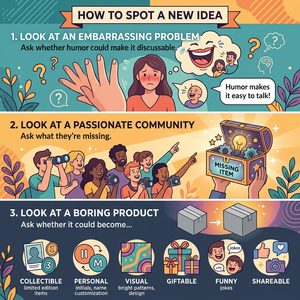
The lesson was learning to see.
Think back to where we started. Most people search for business ideas by asking, “What’s hot right now?” Then they rush toward the same markets everyone else is rushing toward.
Over these four installments, you’ve learned to do something very different.
You can look at a commodity and ask whether it could become premium. Look at an embarrassing problem and ask whether humor could make it discussable. Look at a passionate community and ask what they’re missing. Look at a boring product and ask whether it could become collectible, personal, visual, giftable, funny or shareable.
You can read a one-star review and see a product brief.
You can see a homemade workaround and recognize a prototype.
You can watch someone obsess over a tiny hobby and recognize a market.
You can see people laughing at something and wonder whether the laughter itself has value.
And perhaps most importantly, you’ve learned not to dismiss an idea simply because it initially sounds ridiculous.
Someone sold rocks as pets.
Someone put sleeves on a blanket.
Someone built a fortune around wipes for men.
Someone sold premium water in cans decorated like heavy-metal albums.
Someone made a plastic pickle yodel.
Every one of those ideas could have been killed by one sentence:
“That’s stupid.”
Thankfully, somebody asked a better question:
“But what if it works?”
Your Opportunity Lens Is Yours Now
So here’s my final challenge.
For the next 30 days, don’t go searching for the perfect business idea.
Instead, collect possibilities.
Notice complaints. Watch what people share. Read reviews. Wander through stores. Explore hobbies you know nothing about. Pay attention to products people photograph, gifts people laugh at, things customers modify, communities businesses ignore and little annoyances everyone has learned to tolerate.
Write them down.
Then use everything you’ve learned in this series.
Observe. Ask better questions. Stack the patterns. Test small. Keep improving.
Most of your ideas won’t become businesses.
They don’t need to.
Because you only need one that makes you stop, look at it again and think:
Wait a minute…
Why isn’t somebody doing this?
And someday, perhaps, somebody else will stumble across your wonderfully unexpected business and wonder how on earth you ever thought of it.
You’ll know the answer.
You learned to look where everyone else wasn’t looking.
I deliberately made #50 “The Product That Doesn’t Exist Yet.” I think that gives the entire series a much stronger payoff: after spending months showing readers other people’s unusual ideas, the final example turns the spotlight back on them. It also directly fulfills the promise you made in Part Three—that the goal wasn’t to give them a list of ideas, but to teach them how to find their own.