
Table of Contents
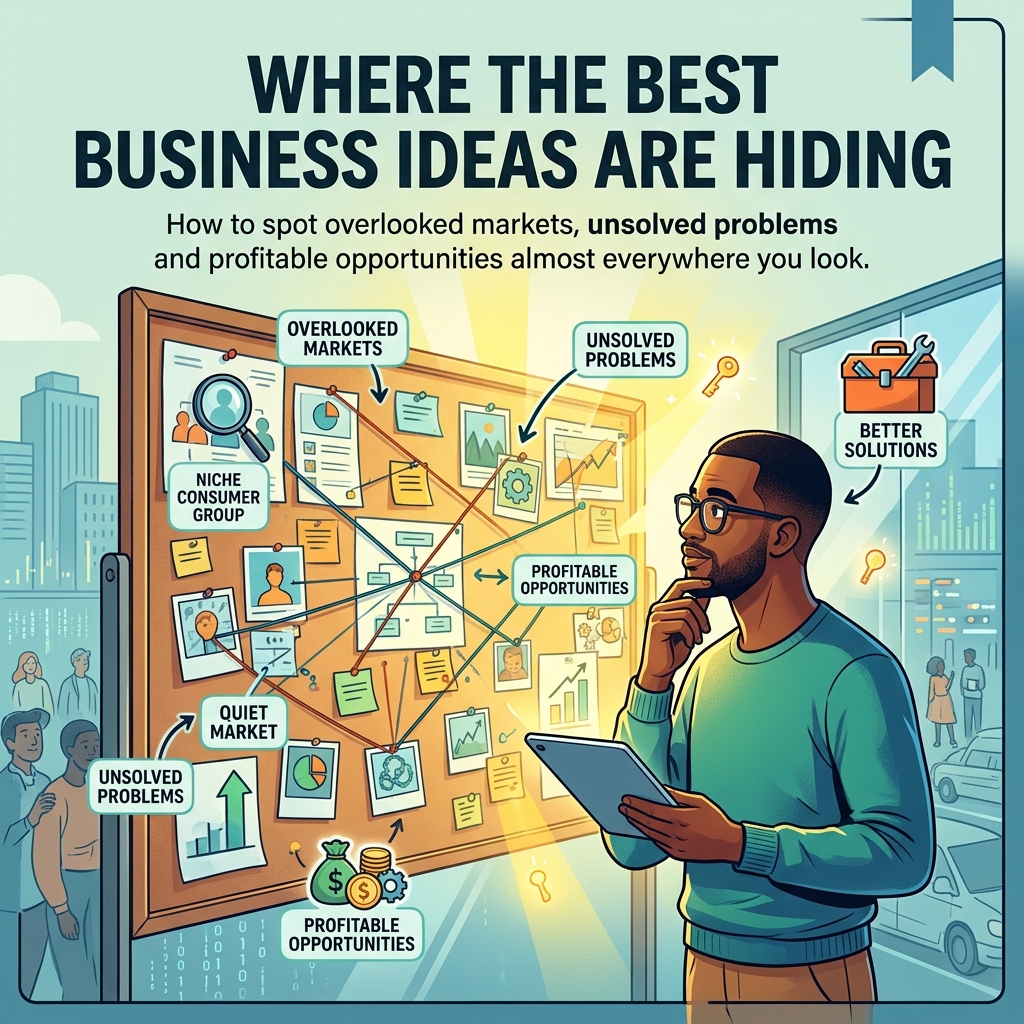
Where the Best Business Ideas Are Hiding
How to spot overlooked markets, unsolved problems and profitable opportunities almost everywhere you look
Welcome Back!
If you’ve been following this series from the beginning, you’ve already discovered one of the biggest myths in business: successful entrepreneurs don’t necessarily come up with better ideas. They learn to recognize opportunities everyone else overlooks.
In Part One, we explored ten unusual products that became remarkable successes, from the Yodeling Pickle and Tortilla Blanket to DUDE Wipes, Squatty Potty, Liquid Death, Doggles and Tiny Plastic Babies. On the surface, they seemed completely unrelated. But underneath, they shared something important: they tapped into powerful elements of human psychology—emotion, identity, curiosity, humor and storytelling.
 In Part Two, we stopped looking at the products and started examining the thinking behind them. You learned to use the Opportunity Lens, explored ten repeatable patterns that appear in successful businesses again and again, and began treating ordinary products as unfinished ideas that could be improved, repositioned or completely reimagined.
Now we’re going hunting. Because knowing how to recognize an opportunity raises an obvious question: Where do you actually find them?
That’s what Part Three is about. We’ll explore why boring industries can be surprisingly profitable, how passionate communities and tiny niches create businesses, and why complaints, customer workarounds, online reviews and overlooked identities can practically hand you ideas. Then we’ll bring everything you’ve learned so far into a five-step Opportunity System you can use whenever you need a new business idea.
And next month, we’ll put that system to the ultimate test with 50 additional real-world businesses and products—from newsletters and digital products to subscriptions, software, collectibles, local businesses and wonderfully strange inventions.
You’ll See What Others Miss
By the end of this series, I don’t want you merely to have a long list of business ideas. I want you to have something far more valuable: the ability to find your own.
I want you to develop the kind of entrepreneurial instinct that makes you notice things other people walk right past. A complaint becomes a clue. A strange little hobby becomes a market. A boring industry becomes an opportunity. A product with hundreds of mediocre reviews becomes an invitation to build something better. Even an ordinary trip through a store can become an exercise in spotting unmet needs, underserved customers and products waiting to be reinvented.
And the wonderful thing about learning this skill is that you never run out of ideas. You no longer have to wait for inspiration or search the internet for somebody else’s list of “hot businesses to start this year.” You know how to look at customers, products, communities, frustrations and changing behavior and ask better questions about what might be possible.
That’s the skill we’re building throughout this series: opportunity recognition. And once you become good at it, the world starts looking different. Instead of seeing businesses that have already been created, you begin noticing the ones that haven’t been created yet.
Where the Best Business Ideas Are Hiding
Business opportunities aren’t randomly scattered across the world. They’re concentrated. Certain places produce great ideas over and over again, yet most aspiring entrepreneurs never think to look there.
Instead, they ask: “What’s trending?” “What’s the hottest business right now?” “What should I sell?” The problem is that thousands of other people are asking exactly the same questions.
Try a better one:
“Where are people overlooking opportunities?”
Now things get interesting. Once you know where to look, you’ll begin finding potential businesses surprisingly often—not because opportunities suddenly started appearing, but because you finally learned where they’re hiding.
1. Boring Industries
Here’s a challenge. Name five exciting industries.
Easy: artificial intelligence, video games, electric vehicles, space exploration and streaming media.
Now name five exciting companies that manufacture industrial hinges.
Not so easy.
That’s exactly the point.
The less glamorous an industry is, the less attention it often attracts. While thousands of entrepreneurs dream about building the next AI startup, someone else is quietly building a seven-figure business selling replacement parts for restaurant refrigerators. Someone specializes in parking-lot striping. Someone rents portable toilets. Another cleans dryer vents. Someone manufactures custom labels for laboratory equipment.
None of these businesses is likely to become the subject of a Netflix documentary. Some can generate remarkable profits. Why? Because entrepreneurs tend to chase excitement. Customers chase solutions.
Never confuse boring with unprofitable. Some extremely successful business owners operate in industries you’ve probably never thought about.
Killer Tip: Look for Expensive Boredom
Don’t just hunt for boring industries. Hunt for boring problems that cost businesses money.
Downtime, compliance, maintenance, scheduling, waste disposal, inventory mistakes, equipment failure and employee training may sound painfully dull. But when failing to solve a dull problem costs a company $10,000, suddenly solving it becomes very interesting.
2. Passionate Communities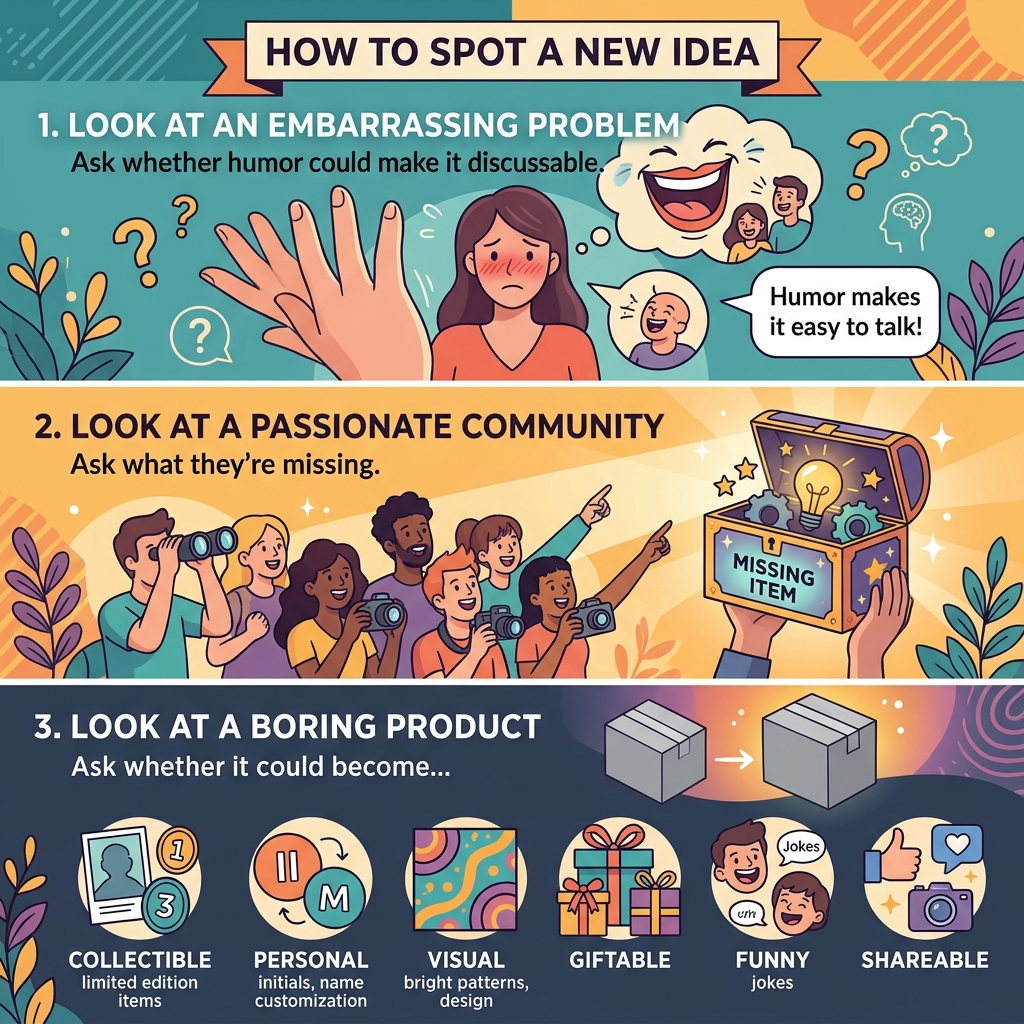
There’s an old business principle worth remembering: Go where the passion already exists.
Communities spend money. Enthusiasts often spend considerably more. Think about fishing, birdwatching, woodworking, cosplay, knitting, model railroads, aquariums, LARPing, chess, magic, beekeeping or genealogy. Each community has its own language, heroes, traditions, inside jokes, problems and—most importantly—needs.
And the deeper people become involved in a hobby, the more specialized those needs become. That’s opportunity.
Don’t assume you need millions of customers. Sometimes a relatively small group of people who genuinely love what you create can support an excellent business.
And here’s the question from Part Two’s Passion Markets pattern that becomes especially valuable:
What are these people missing?
Don’t merely study what enthusiasts already buy. Find what they wish existed.
3. Tiny Niches
One of the internet’s greatest gifts to entrepreneurs is that it made tiny markets economically viable.
Twenty years ago, building a business exclusively for backyard-chicken owners would have been difficult. Today, those customers can gather through YouTube channels, Facebook groups, websites, newsletters, online stores, courses and communities. The same is true of vintage-camera collectors, miniature painters, home coffee roasters, RV renovators, urban gardeners, historical reenactors, mechanical-keyboard enthusiasts, soap makers and mushroom foragers.
Tiny niches aren’t necessarily limitations. They can be foundations.
People within specialized niches often become repeat customers, recommend useful businesses to other enthusiasts and trust specialists more than generalists. Generalists frequently compete on price. Specialists can compete on expertise. That’s a much nicer business to own.
Look for Niches Inside Niches
Don’t stop at “gardening.” Try apartment gardening. Then balcony vegetable gardening. Then vegetable gardening for apartment dwellers with north-facing balconies.
Eventually a niche becomes too small—but entrepreneurs frequently stop narrowing long before they reach that point. Sometimes the profitable opportunity isn’t finding a giant audience. It’s becoming the obvious choice for a very specific one.
4. Everyday Frustrations
Pay attention to complaints. They’re business ideas wearing disguises.
Every time someone says “I wish…” “There has to be a better way…” “This is so annoying…” or “Why is this so complicated?” you’ve encountered a possible opportunity.
Keep a running list. Not every frustration deserves a business, of course. But many successful companies began because someone became irritated by something everybody else had simply learned to tolerate.
The frustration came first. The solution came second.
Your everyday life is filled with opportunities disguised as inconveniences. The trick is noticing them before you forget them.
5. People Are Already Hacking Products
One of my favorite places to discover business ideas isn’t in stores. It’s in people’s homes.
Watch how people modify products they already own. Someone wraps tape around a tool handle because it’s uncomfortable. Someone creates a homemade storage system. Someone develops a kitchen hack. Someone repurposes a container to hold something it was never designed for.
Those modifications are clues. Customers frequently invent tomorrow’s products before companies do.
Remember the Tiny Plastic Babies from Part One? Customers transformed an ordinary party favor into an ongoing prank. The company didn’t invent that use. The customers did.
Whenever you see someone altering, combining, repairing, adapting or repurposing a product, ask:
“What problem are they solving that the original product didn’t?”
That homemade workaround may be a prototype nobody realizes is a prototype yet.
6. The Comments Section Is a Gold Mine
Want one of the easiest opportunity exercises you’ll ever do? Read reviews.
But don’t start with the five-star reviews. Read the one-star reviews. Then read the three-star reviews.
Customers will happily tell you what’s missing, confusing, overpriced, badly designed, frustrating or almost perfect. Pay particular attention to four words:
“I love it, but…”
Those words are gold. They tell you the customer already wants the product. You don’t necessarily need to convince them to buy the category. You may simply need to fix the “but.”
Then go beyond product reviews. Read YouTube comments. Browse Reddit discussions. Visit Facebook groups. Read Amazon questions. People openly discuss problems businesses haven’t solved yet.
It’s free market research. All you have to do is listen.
The “Repeated Complaint” Rule
One complaint is interesting. Ten unrelated customers making essentially the same complaint is something worth investigating.
Don’t just collect complaints. Count them.
Repetition is evidence.
7. Look Where People Spend Time
Follow attention. Not hype.
If people consistently gather somewhere, opportunities usually follow. That doesn’t necessarily mean social media. It might be a farmers market, comic convention, pickleball league, dog park, camping expo, quilting retreat, fantasy-football forum or neighborhood Facebook group.
Any place where people gather repeatedly develops needs: food, merchandise, education, entertainment, services, accessories, software and community.
This is especially powerful when a community is growing faster than businesses are appearing to serve it.
Where sustained attention goes, businesses eventually follow.
Your opportunity may be arriving first.
8. Look for Identity Before Products
This may be one of the most important ideas in the entire series.
Don’t begin with products. Begin with people. More specifically, begin with identity.
Someone isn’t simply a runner—she’s training for her first marathon. Someone isn’t simply a parent—he’s homeschooling twins. Someone isn’t merely retired—she’s restoring a 1967 Mustang. Someone isn’t simply a gardener—he’s obsessed with growing giant pumpkins.
Identity creates specificity. Specificity creates opportunity.
This connects directly to something you learned in Part Two: Identity Beats Utility.
Once you understand not merely what somebody does, but **who that person believes they are—or wants to become—**creating products, services, communities and marketing for them becomes dramatically easier.
Opportunity Challenge #3: Become an Opportunity Collector
This week’s exercise requires no money, software or brainstorming session. Carry a notebook—or use the notes app on your phone—for seven days. Every time you notice one of these things, write it down:
- A complaint
- An unusual hobby
- A product someone modified
- A business with surprisingly little competition
- A funny or highly shareable product
- A long line of waiting customers
- A product people keep photographing
- Something that makes you say, “I didn’t know that existed.”
Don’t evaluate anything yet. Just collect.
Your goal isn’t to invent a business this week. Your goal is to become an opportunity collector. After seven days, review your notes. You may notice certain frustrations appearing repeatedly, certain communities seeming underserved, or several observations involving the same kind of customer.
Pay attention to those repetitions. Patterns always matter.
Curiosity Is Your Greatest Competitive Advantage
People often ask successful entrepreneurs, “How did you think of that?”
The answer is usually less exciting than people expect. They noticed something. Then they kept asking questions.
Curiosity isn’t merely a personality trait. It’s a business skill. Children ask hundreds of questions. Adults gradually stop. Entrepreneurs start asking again.
Why do people buy this? Why is it packaged that way? Why isn’t there a version for teachers? Why hasn’t anyone combined these two ideas? Why are customers using it differently than intended? Why is everyone competing over there? Why is nobody looking over here?
Ask enough questions for long enough and something begins to change.
The World Starts Looking Different
Eventually, you stop walking through stores. You walk through possibilities.
You stop seeing products and begin seeing stories, communities, identities, emotions, transformations, problems and experiences. You’ll notice a garden hose and wonder whether there’s a premium version for serious gardeners. You’ll see a puzzle and imagine a monthly subscription club. You’ll watch a child playing with a cardboard box and think about creativity kits. You’ll visit a museum gift shop and notice products people would happily buy online all year.
The world hasn’t changed. Your perspective has.
That’s opportunity recognition. And once you’ve developed it, it’s remarkably difficult to turn off.
Bringing It All Together: Your Five-Step Opportunity System
We’ve now reached an important point in our journey. Part One showed you what overlooked opportunity looks like. Part Two taught you how to recognize its patterns. And Part Three has shown you where to go looking for it.
Now let’s turn all three lessons into a system. Whenever you’re searching for your next business idea, come back to these five steps.
Step One: Observe
Most people rush toward solutions. Don’t. Become an observer first.
Pay attention to complaints, hobbies, traditions, collections, identities, passionate communities, funny products, customer modifications and things people can’t stop photographing or talking about. Don’t immediately decide whether something is a business. Collect evidence first.
Every observation becomes another puzzle piece. The more pieces you collect, the easier it becomes to recognize patterns other people overlook.
Step Two: Ask Better Questions
Instead of asking “What should I sell?” ask:
Why does this exist? Who loves it? Who else might love it? Why hasn’t anyone marketed it differently? Could it become premium? Could it become funny? Could it become personalized? Could it become a subscription? Could it become a community?
This is the Opportunity Lens from Part Two in action.
Questions create possibilities. And the quality of your ideas is often determined by the quality of your questions long before you begin searching for answers.
Step Three: Stack the Patterns
Now take the patterns you’ve learned and begin combining them. Could your observation become a conversation starter, an identity product, a transformation, a collectible, a gift, an experience, part of a tribe, visually satisfying, humorous or simply a better story?
Don’t search for one magical insight. Stack possibilities.
One pattern can produce an interesting idea. Two can make it distinctive. Three or four can sometimes produce something people haven’t seen before.
Step Four: Test Small
Here’s where many aspiring entrepreneurs make their biggest mistake: they fall in love with the idea.
Don’t. Fall in love with learning.
Instead of spending months and thousands of dollars creating the perfect product, test the smallest meaningful version you can. Could you create a landing page? An Etsy listing? A Gumroad product? A preorder page? A Kickstarter? A waiting list? A simple social post showing the concept?
Modern entrepreneurs have an extraordinary advantage: you can often test interest before fully building the thing.
You don’t need certainty. You need evidence. Let prospective customers tell you whether you’re heading in the right direction.
Step Five: Keep Improving
Here’s something people rarely talk about: the first version of a successful business is almost never the final version.
Amazon began with books. Netflix mailed DVDs. Nintendo sold playing cards long before video games became its defining business. Businesses evolve.
Your first version gets you moving. Customers and evidence help determine what comes next. That’s why launching beats waiting.
Perfect businesses don’t exist. Improving businesses do.
Five Mistakes That Can Kill a Great Opportunity
Before we finish, let’s deal with a few traps. 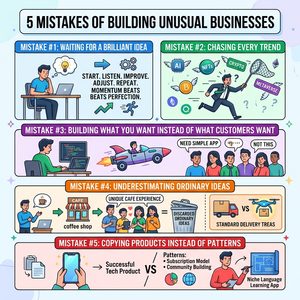
Mistake #1: Waiting for a Brilliant Idea
Most successful businesses don’t arrive fully formed. They evolve. A decent idea becomes a good idea. A good idea becomes a better offer. Customer feedback improves it further.
Start. Listen. Improve. Adjust. Repeat.
Momentum beats perfection.
Mistake #2: Chasing Every Trend
- Crypto. NFTs. Virtual reality. Whatever everyone is talking about next Tuesday.
Trends absolutely create opportunities. They also create crowds. Sometimes the better opportunity is quietly serving a market everyone else considers boring.
Remember Part One. Most of those businesses weren’t trendy. They were memorable.
There’s a difference.
Mistake #3: Building What You Want Instead of What Customers Want
Entrepreneurs spend months creating something they personally love. Then customers shrug.
Passion matters. Curiosity matters. Demand matters more.
Listen before building. Observe before assuming. Test before investing heavily. Let customers help guide you toward the business they actually want—not the business you think they should want.
Mistake #4: Underestimating Ordinary Ideas
“A blanket? Cleaning paste? Wet wipes? A koozie?”
How big could those possibly become?
As you’ve already seen, surprisingly big.
Never judge an opportunity solely by how ordinary its product appears. Judge it by how effectively it solves a problem, creates an emotion, strengthens an identity, sparks conversation or tells a memorable story.
Mistake #5: Copying Products Instead of Patterns
This may be the most important lesson in the series.
Don’t copy Liquid Death. Copy the thinking behind Liquid Death.
Don’t create another Squatty Potty. Understand why Squatty Potty worked. Don’t invent another Tortilla Blanket. Ask what completely ordinary product could benefit from an equally surprising transformation.
Products come and go. Patterns endure.
Train Your Brain Every Day
You don’t become great at spotting opportunities by reading one article series. You become great by practicing.
Fortunately, practice is everywhere.
The next time you’re browsing Amazon, don’t just shop—study. When you’re scrolling TikTok, look beyond the entertainment and ask why certain products spread. When you walk through Costco, pretend you’re a product developer. Study packaging. Watch shoppers. Notice where they stop, what they pick up and what they put back.
Even the impulse-buy section near the checkout is a miniature marketing laboratory. Why those products? Why those colors? Why those prices? Why are they sitting there?
Become endlessly curious. Eventually, your brain starts doing this automatically.
One Final Challenge: 30 Ideas in 30 Days
For the next 30 days, write down one business idea every day.
Not one brilliant idea. Just one.
Some will be terrible. Good. Some will be impossible. Excellent. Some will already exist. That’s fine, too.
The goal isn’t perfection. The goal is volume.
Something interesting happens after you’ve generated 20 or 30 ideas: the obvious answers begin running out. Your brain is forced to make connections it wouldn’t normally make. That’s where some of the most interesting ideas appear.
Professional comedians don’t write one joke; they write hundreds. Inventors don’t explore one possibility. And successful entrepreneurs don’t sit around waiting for inspiration.
They generate possibilities until one refuses to be ignored.
The Opportunity Is Bigger Than You Think
Most people look at the world and see finished products, finished companies, finished industries and finished markets.
Entrepreneurs see unfinished stories: products waiting for better positioning, communities waiting for someone who understands them, customers waiting for better solutions, and ideas waiting to be combined in ways nobody has tried.
That’s the larger lesson running through all three installments so far.
The world isn’t running out of business opportunities. If anything, it’s creating more. Every new technology creates new problems. Every new hobby creates communities. Every new generation develops identities. Every cultural shift creates needs.
Opportunity isn’t disappearing. It’s multiplying.
The question is whether you’re training yourself to recognize it.
Next Month: 50 Businesses, 50 Opportunities to Practice
You’ve come a long way since that yodeling pickle.
In Part One, ten wonderfully strange businesses showed us that profitable ideas don’t always begin with revolutionary inventions. Sometimes somebody simply sees an ordinary thing differently.
In Part Two, you learned how to do that deliberately, using the Opportunity Lens and recurring patterns behind successful businesses.
And in Part Three, you’ve learned where to hunt: overlooked industries, passionate communities, tiny niches, frustrations, customer workarounds, reviews, identities and the countless little clues most people ignore. Most importantly, you now have a five-step system for turning those observations into possibilities.
But there’s one thing left to do: practice.
That’s what the fourth and final installment is going to give you. Next month, we’ll examine 50 additional real-world businesses and products spanning digital products, newsletters, memberships, software, subscription services, local businesses, collectibles, unusual inventions and overlooked niches.
But this time, I don’t want you simply reading their stories. I want you reverse-engineering them.
For every example, ask: What pattern is hiding here? What problem is this really solving? What identity or community does it serve? Where did the entrepreneur spot the opportunity? And most importantly: What completely different idea could I create using the same pattern?
That last question changes everything.
Because the 50 businesses in Part Four aren’t really the point. They’re 50 practice rounds for your newly trained Opportunity Lens.
And somewhere among those 50 examples, one pattern, one customer problem, one unusual niche or one unexpected connection may spark an idea that’s entirely your own.
I’ll see you next month for the grand finale.