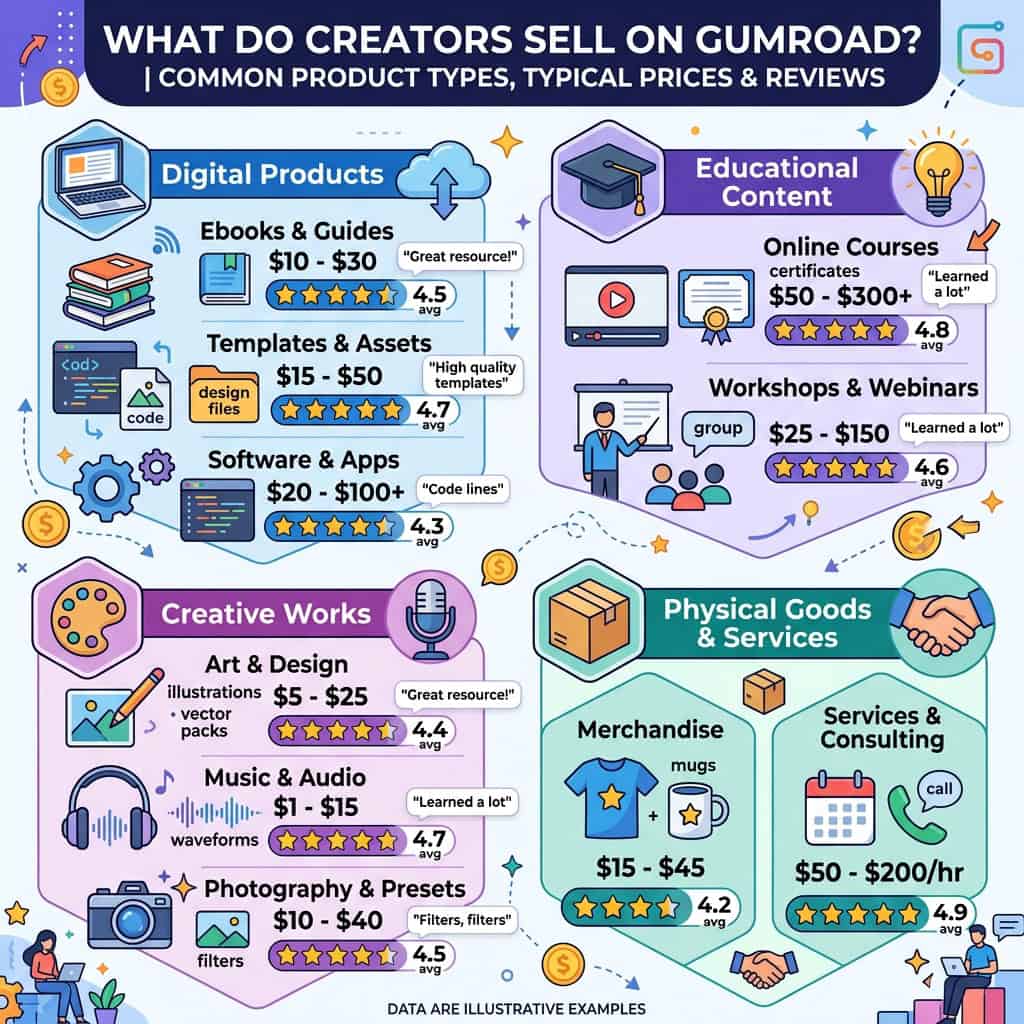

Wondering how to sell on Gumroad? You and several thousand others! At any time, there are roughly 26,000 to 44,000 active sellers on Gumroad. Most sellers never make real money, so learn how the winners succeed.
The internet loves a Gumroad success story. A creator uploads a digital product, and a few months later they’re posting screenshots of $10,000 weekends and sales notifications rolling in while they sleep. The platform makes it look almost insultingly simple: Upload a file, set a price, share a link, wait for the money.
The reality is a little less cinematic.
An analysis of 146,271 Gumroad products found that the median product sells just 28 times at a $13 price point – roughly $364 in total revenue over its entire lifetime. And 44% of products earn exactly $0. The most extreme stat of all: The top 1% of sellers control 99.5% of total platform revenue.
At first glance, that sounds like a warning. It isn’t. It’s actually a roadmap – because those numbers tell you exactly what the losing strategy looks like, which means you can stop doing it immediately. Most people aren’t failing because the opportunity is bad. They’re failing because they’re treating Gumroad like a vending machine instead of a business. Upload something, set a price, hope for the best. That’s not a strategy. That’s a lottery ticket.
Here’s what an actual strategy looks like.
Start With Problems, Not Products
The biggest misconception in digital product businesses is that you need a great product, but you don’t – at least not first. 95% of info-products fail because creators build first and think about the market later. Thousands of creators spend weeks building courses, templates, ebooks, and planners that nobody asked for. Then they launch. Then they wait. Then they wonder why nothing happens.
The problem isn’t quality. It’s demand.
Successful Gumroad creators don’t start by building products. They start by watching what people complain about, noticing repetitive questions in communities, and finding the frustrations and bottlenecks their audience already has. Then they build solutions. Before building anything, search for your product idea on Gumroad – ideally you want three to ten competitors as proof of demand – then read Reddit threads about your audience’s pain points. If you get 20 or more enthusiastic responses when you float the idea, that’s a green light. If you can’t fill in the sentence “this helps [specific person] stop struggling with [specific problem]” – you don’t have a product yet. You have a file.
The Real Asset Isn’t the Product – It’s the Audience
Here’s something most beginners miss entirely: The product is not the asset. The audience is. A digital product can disappear tomorrow. An audience can buy from you for years.
This is why some creators launch mediocre products and still make money – they’re not selling to strangers, they’re selling to people who already trust them. Easlo – Jason Ruiyi Chin from Singapore – has earned over $500,000 from Notion templates using a completely replicable strategy: Share high-quality free templates, drive traffic from Twitter, collect emails, then sell premium products at $99 and above. His “Second Brain” template alone generated over $100,000. The templates mattered. But the audience mattered more. He built attention before he needed it, and when he finally asked people to buy, he wasn’t pitching to strangers.
The lesson isn’t “sell Notion templates.” The lesson is build the audience first.
Pricing: Stop Leaving Money on the Table
Most beginners price at $5 because it “sells in volume.” The data says the exact opposite. The $30–$49 range converts 28% better than products under $10 and has the highest breakout rate across the entire dataset. On a $9 product, processing fees alone eat 6.2% of your revenue. Price around $29 and you hit the impulse-buy zone with a healthy margin. Stop undervaluing your work.
For your very first product, consider the Pay What You Want approach. PWYW products hit ten or more ratings at a rate of 20.8% versus 8% for fixed-price products – about 2.6 times higher engagement. It removes the price barrier, gets people in the door, and makes the next sale far easier. Once you have social proof, move to fixed pricing and watch your conversions climb.
Reviews Are Everything – Chase Them Like Your Business Depends on It
It does. Products rated 4.5 to 4.9 stars average 1,197 sales. Products with no rating average just 18 – a 66x gap. Even bad reviews (1 to 2.9 stars) generate 3.4 times more sales than zero social proof.
Reviews reduce fear, and fear is the biggest enemy of conversion. People can’t hold a digital product, flip through the pages, or test-drive the experience before buying. Reviews are the closest thing to that reassurance. Your first ten customers are often more important than your next hundred – they’re not just buyers, they’re proof. Email them directly, offer a bonus in exchange for honest feedback, and start the review flywheel spinning: More reviews lead to more sales, which lead to more reviews.
Build a Catalog, Not a One-Hit Wonder
Single-product sellers average 269 sales. Sellers with 11 or more products average 5,201 sales – a 19x increase. Every product becomes a doorway. Someone discovers your checklist. Someone else finds your template. Someone else buys your guide. Different people enter through different doors. The creator with one product has one chance to be discovered. The creator with twenty products has twenty chances.
Think of your digital product business like a bookstore. Nobody walks in for a single title – they walk in because there are hundreds of opportunities to find something useful. Build toward a catalog of ten to twenty products over the next six to twelve months, and watch each new product make all the others sell better through cross-selling and internal discovery.
Instead of selling one $7 planner, build a “Complete Productivity Vault” for $27 with five related products. Perceived value is far higher, margins are nearly 100%, and you pay the $0.50 fixed fee once instead of five times. Use price anchoring: “$59 value – today just $27.”
Your Product Page Is a Sales Page – Treat It Like One
Most Gumroad product pages read like a directory listing. That’s a wasted opportunity. Use the Problem → Agitate → Solution → Proof → Offer formula. Your headline must focus on the outcome, not the features. Add testimonials, a clear cover image of at least 600x600px, and an FAQ section that handles the most common objections before they form in the buyer’s head. Turn on upsells and order bumps – Gumroad’s one-click upsell features have already generated an extra $150,000 for creators since launching. And enable Guest Checkout – forcing account creation is one of the leading causes of cart abandonment.
Traffic Is Still the Whole Game
Here’s the uncomfortable truth nobody puts in the headline: Gumroad is not a marketplace in the way most people imagine. Unlike Etsy, Gumroad doesn’t have a busy marketplace where strangers browse. You have to bring the traffic yourself. Twitter and X have proven to be the biggest drivers for Gumroad stores – far bigger than Instagram.
The creators who win understand this from day one. They write articles. They post videos. They build newsletters. They participate in communities. They create free resources that build email lists. Direct traffic and email converts at 5.8% – far above social media at 2.4%. Gumroad’s built-in Workflows feature handles automated emails after purchase, for new subscribers, and for abandoned carts – all free, no additional tools needed.
The product isn’t the business. The product is what marketing sells.
The Compounding Effect Nobody Warns You About
Most creators quit too early. The first few months feel slow – a handful of sales, a few subscribers, some encouraging comments, not much money. Then something shifts. Content starts ranking. Reviews accumulate. Products cross-sell each other. Email lists grow. Word-of-mouth begins. The system starts helping itself.
The turning point usually arrives between months four and six. Most people quit before month six and never see the compounding effect. What looked like painfully slow progress suddenly becomes momentum – and the creators who appear to come out of nowhere aren’t overnight successes. You just didn’t see the hundreds of days they spent building the foundation before the flywheel started spinning.
Watch seasonal patterns too – January is typically the sales peak, while July and August are the slowest months. Use the slow season to build new products, not push promotions nobody wants.
The Real Opportunity
The real opportunity on Gumroad in 2026 isn’t selling a PDF. It’s building a digital asset ecosystem. One free product leads to an email subscriber. One subscriber becomes a customer. One customer buys additional products. One happy customer refers others. One product becomes five. Five becomes twenty. Twenty becomes a business.
The creators earning meaningful income aren’t chasing a viral launch or a perfect product. They’re building systems that compound – through consistency, audience trust, and the patience to let the flywheel do its work. The platform itself isn’t the opportunity. What you build around it is.
Your action plan is simple: Pick a specific niche, validate demand before building, launch one free or Pay What You Want product to collect reviews and emails, then build a paid product in the $25–$50 range with a page that actually sells. Repeat until you have a catalog. Drive traffic from one platform you commit to properly. Build the email list. Let time do its thing.
Start Selling on Gumroad
Digital products are one of the most accessible ways to build real income from what you already know.
The only thing left is to start.
Short of something to create a digital product from? Save yourself the research. Check out the contents of this vault here (affiliate link).





Hi Joy. I recently added my Travel Hacks eBook to the Gumroad platform. I had offered it as a free download directly from my travel blog, and then, following Ryan Biddulph’s lead, I set up a Gumroad account.
After 10 days, i sold my first eBook for 10 USD. I had 113 downloads when it was free (possibly a mistake, but that’s how it went).
Maybe the Pay What You Want approach would be better.
Thanks for the write-up
Trevor
Interesting Trevor – perhaps I will have to try that approach too.
Glad to hear from you.