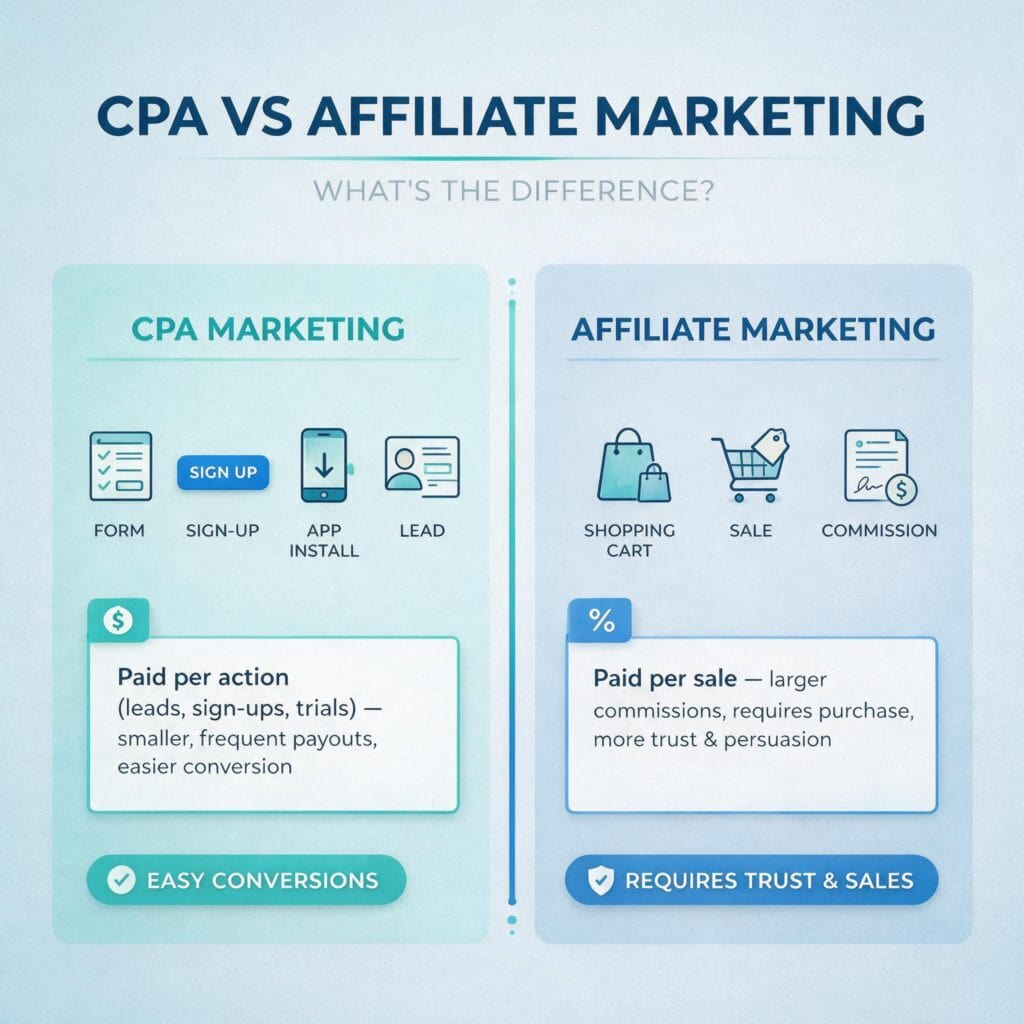

I have recently started learning CPA marketing, and needed to get clear in my head the difference between CPA marketing and Standard Affiliate Marketing.
Here’s what I found – courtesy of AI!
Standard Affiliate Marketing (what you may already have been doing)
- You promote a product and earn a commission when someone buys it
- Payout is usually a percentage of the sale (e.g., 50% of a $97 product = $48.50)
- The visitor has to spend money for you to earn
- Conversion rates are lower because you need someone to pull out their credit card
- Examples: ClickBank products, Amazon Associates, WarriorPlus
CPA (Cost-Per-Action) Marketing (what CommissionOS focuses on)
- You earn when someone completes a specific action – NOT necessarily a purchase
- The action can be: email submit, zip code entry, app install, survey completion, signing up for a free trial, etc.
- Payout is a fixed dollar amount per action (e.g., $2.50 per email submit)
- Conversion rates are much higher because the action is free/easy for the visitor
- Examples: “Win a $500 Amazon gift card — enter your email” sweeps offers, VPN installs, app downloads
The Key Difference in One Sentence:
Standard affiliate marketing = you get paid when someone buys. CPA marketing = you get paid when someone does (even a free action).
The Difference in a Table
CPA (Cost Per Action) marketing is a subset of affiliate marketing, but when people contrast the two they’re usually comparing action-based payouts (leads, sign-ups, etc.) versus sale-based commissions.
| Aspect | CPA Marketing | Affiliate Marketing (sale-focused) |
|---|---|---|
| What triggers payment | A specific action: form fill, sign-up, app install, free trial, lead, sometimes a first purchase. | A completed sale (or sometimes a recurring subscription) via your affiliate link. |
| Payment model | Fixed payout per action (e.g., $2–$50 per lead), often smaller but more frequent. | Commission per sale (percentage of order value or fixed amount), usually larger but less frequent. |
| Difficulty of conversion | Easier for the user: no purchase required, just an action. | Harder: user must decide to buy, often needing more trust and persuasion. |
| Typical offers & sources | Offers from CPA networks aggregating many advertisers across niches (lead gen, finance, health, apps, etc.). | Often direct merchant/brand programs or affiliate networks focused on product sales (e-commerce, SaaS, courses, etc.). |
| Traffic & strategy | High-volume, often paid or broad-appeal traffic (pop/native ads, social ads, simple landing pages). | More content/relationship-driven: blogs, reviews, tutorials, email lists, YouTube, social authority. |
| Entry requirements | Often stricter approval via CPA networks; more scrutiny on traffic quality and methods. But the training I am using identifies several with instant approval. | Generally easier to join many programs; lower barriers, especially for content creators. |
| Asset needs | Often just a squeeze/landing page and ads; a full website not always required. | Commonly uses websites, blogs, channels, or established audiences, though not strictly mandatory. |
| Earnings pattern | Quick, smaller payouts; income depends on volume and testing many offers. | Slower to scale but potentially higher long-term value, especially with high-ticket or recurring commissions. |
| Risk profile | Lower risk for advertisers (pay only for actions); affiliates risk ad spend vs lead quality/approvals. But as I learned in my course there are some free sites. | Higher risk for advertisers (pay only on sales); affiliates risk time/content investment before seeing sales. |
| Tracking complexity | Needs solid conversion tracking but often simpler funnels (action = conversion). | Often needs more sophisticated tracking (cookies, attributions, multi-touch, recurring billing). |
How they relate
- Affiliate marketing is the broad performance-based model where you earn commissions for driving sales.
- CPA marketing is a specific payment structure within affiliate marketing where the “result” is a defined action, not necessarily a sale.
In practice:
- Choose CPA if you want faster, smaller payouts and are comfortable running search out high-volume traffic, leaving offers to run and waiting for commissions
- Choose sale-based affiliate marketing if you prefer building content/audience trust and aiming for bigger, more sustainable commissions.
Learn CPA Marketing
So from my research above I concluded that there was less need to build the trust that seems to be so hard to gain in today’s online market, and CPA marketing might be easier for beginners to online marketing.
And indeed for myself too – I seem to spend an inordinate amount of time on Facebook with other marketers all trying to establish “trust”, to buy from each other, products we already bought! Crazy?
Obviously I will continue with my standard affiliate marketing as that has been successful for me, and hopefully those I have introduced to training such as the ClickBank Profit Club (shown elsewhere on this blog) will continue learning, and maybe add CPA marketing as one of their skills.
Although I don’t yet have high volumes of traffic, the CommissionOS training covers where to find that, included some free or extremely low-cost sources.
So to try CPA marketing I purchased Dimitris Papadopoulos’s training CommissionOS. Dimitris is a well-known and reliable marketer I have followed for some time now, and bought several of his products. He is famed for earning commissions online using a particlar method (in this case CPA marketing) then developing tools to simplify and automate the methods. This is what he has done with CommissionOS.
You can see his proof of earnings here CommissionOS offer (affiliate link)