

Table of Contents
Your Analytics Are Lying to You and Dark Social Is the Reason
Something strange is happening inside your analytics dashboard.
People are reading your content. They’re talking about your brand. They’re recommending your newsletter, sharing your links, and sending your ideas to friends and colleagues.
Yet your reports seem oddly quiet.
Where did all those visitors come from?
Your analytics don’t know.
But there’s a good chance dark social does.
Dark social refers to content shared through private channels—WhatsApp groups, Slack communities, text messages, DMs, email forwards, Discord servers, group chats, and countless other places where analytics tools can’t easily follow. When someone clicks one of those links, it often shows up as “direct traffic,” making it look as though visitors magically appeared out of nowhere.
The truth is they’re not appearing out of nowhere.
They’re arriving because someone they trust recommended you.
And that’s why dark social matters.
For years, marketers obsessed over public platforms where every click, like, and share could be measured. But social media has become increasingly noisy, crowded, and performative. Many of the most meaningful conversations have quietly migrated into private spaces where people can talk freely without broadcasting their opinions to the entire internet.
That’s where trust lives.
And trust is difficult to measure.
The challenge for marketers is that dark social doesn’t behave like a traditional channel. You can’t easily optimize it, track every interaction, or create a perfect attribution model.
But you can earn it.
Create content people want to forward to a colleague. Publish insights that make someone think, “I need to send this to my team.” Develop frameworks worth screenshotting, saving, and sharing in private conversations.
In other words, stop creating content solely for algorithms.
Start creating content for people.
Because the most valuable marketing often isn’t happening on a public timeline.
It’s happening inside private conversations you’ll never see.
And that mysterious spike in direct traffic?
It might not be untraceable traffic at all.
It might be trust.
Which is ideal…..
But are we in a trust recession?
While agreeing with the above, my current experience is that trust online – from newcomers – is harder and harder to earn, because they have been ‘burned’ so badly in the past by some of the conmen preying on newcomers, with promises of instant wealth.
Some see my ‘it takes hard work and time’ approach as boring, so who would want to bother with that when there are all these other exciting fast money deals just waiting? (NOT!)
Others may even wonder if I have some double-bluff waiting to catch them.
But the most difficult challenge is finding newcomers before they are ‘burned out’.
We are in a trust recession.
There are people online who trust me, and whom I trust – but we’re probably all in the same business already, so while we ‘Like and Comment’ on each others’ posts, it’s all a bit pointless because we are supporting each other rather than making new contacts. (Who won’t yet trust us – for a long time probably.)
What’s even worse for me is feeling that someone trusted me enough to join a business I recommended, but still didn’t earn any commissions, maybe because they hadn’t built up enough trust with their own audience.
Should you dispense with trust?
Trust is all well and good but it doesn’t put money in the bank, and let’s face it – that’s why most people are in online businesses. And at my age (mid 70s) how long can you wait?
I shall continue to work on building trust with strangers (by sending emails, and writing blog posts) but I am also exploring another approach, where less trust is needed because I can make commissions without making sales.
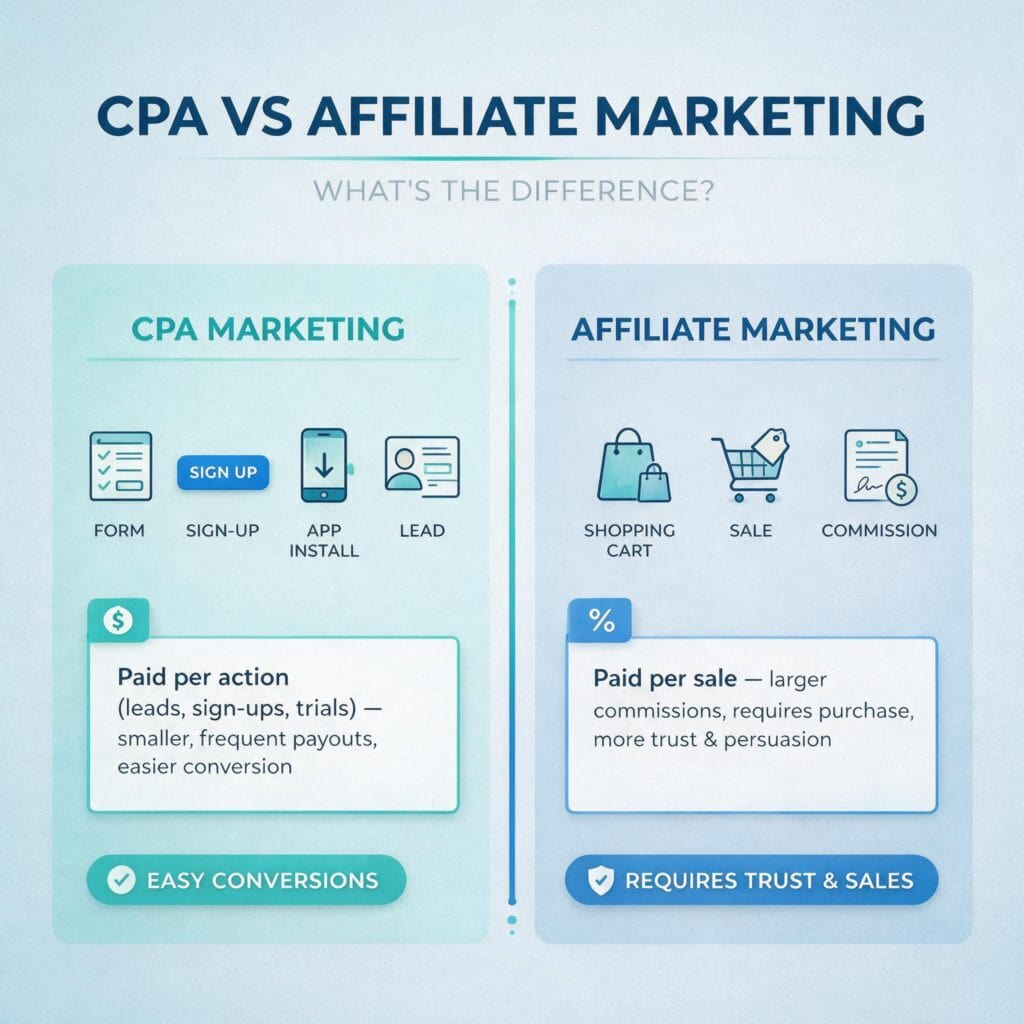
That’s CPA marketing. I have a full (probably too wordy!) article on the difference between CPA marketing and standard affiliate marketing here.
But, in a nutshell:
Standard affiliate marketing = you get paid when someone buys. CPA marketing = you get paid when someone does (even a free action).
So – because ‘someone’ doesn’t spend anything, less trust is required. Almost certainly a lower commission, but better than nothing – and if you get them on your email list, you can continue building trust too, and they have the choice to unsubscribe.
If this possibility of earning with CPA marketing interests you, learn more here.




Wow Joy. This is my kind of topic. I love this stuff because most of what I do depends on referral marketing. Or the dark social you mention, the channels no one thinks about and typically misses while scouring metrics.
I may leave a genuine comment like this one. Let’s say you appreciate the comment. Feeling appreciative inspires you to stop by my blog to drop a comment. Our bond grows. As it strengthens, you decide to share one of my blogging eBooks with one of your readers via Messenger. The following day, I see a Gumroad sale via my Gmail Promotions tab from that individual.
Being outside of my network until that moment, I have no clue where they originated or how they found my eBook. But this underscores why building rock solid friendships with bloggers is paramount. I can only do so much as one blogger. But helping other bloggers inspires some to send readers and customers to my blog through channels I know not, nor could I consistently track these streams.
Make blogging friends by being truly helpful. Blogging friends amplify your blogging traffic and income through all manner of channels. Move the focus from trying to work channels to helping friends who then take care of the rest, referral-style.
Sensational message.